In 2019, a literature review indicated that more than half of people who try to come off antidepressants experience withdrawal effects. Both the National Institute of Health and Care Excellence and the Royal College of Psychiatrists updated their positions in line with that review, and Public Health England published a 152-page report called Dependence and withdrawal associated with some prescribed medicines: an evidence review. The report made several recommendations relevant to general practice.
In order to facilitate implementation of these recommendations, an online survey was designed to explore United Kingdom general practitioner (GP) experiences, opinions, knowledge and needs in relation to depression, ADs and withdrawal. A total of 66 GPs had completed the survey when COVID-19 occurred.
In keeping with previous findings, this small sample of GPs had a predominantly psycho-social perspective on the causes of, and treatments for, depression. They broadly considered ADs effective for moderate/severe depression and ineffective for minimal/mild depression, for which they preferred psychological therapies and social prescribing. There was a marked lack of consistency in GPs’ knowledge about the incidence and duration of withdrawal effects. Only a minority (29%) felt their knowledge about withdrawal was ‘adequate’ and fewer (17%) believed this about their ‘Ability to distinguish between withdrawal effects and return of the original problem (e.g. depression)’. Two-thirds (68%) would like more training on these matters.
It is hoped that even this small sample will be helpful when designing, and seeking funding for, GP training programmes, and when implementing the PHE recommendations for support services, based in the primary care system, for the millions of people contemplating or initiating withdrawal from ADs every year in the UK.
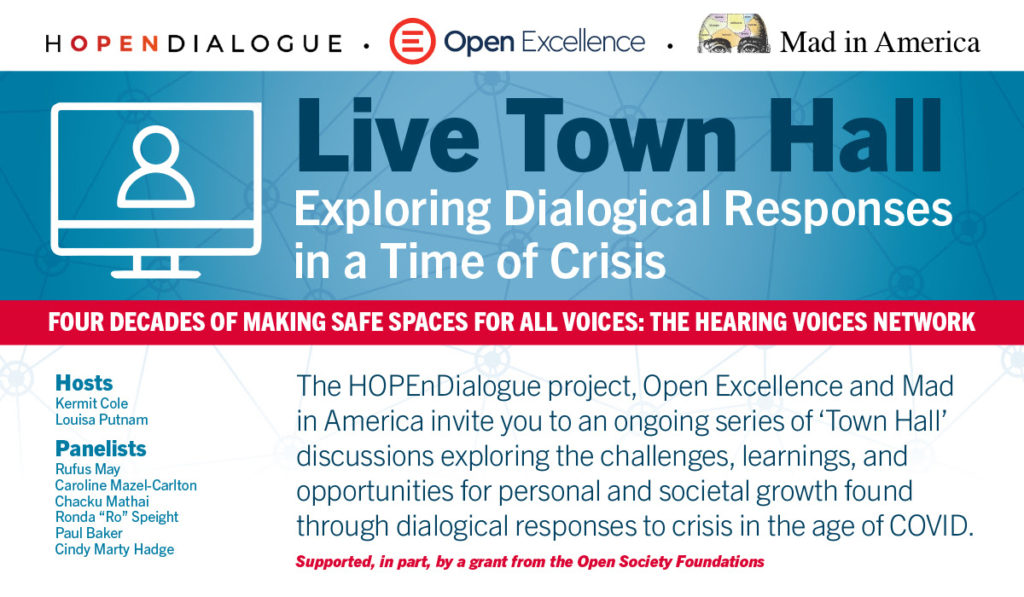

In 1987 Patsy Hage said to her psychiatrist, Marius Romme, “You believe in a God we never see or hear, so why shouldn’t you believe in the voices I really do hear?” This was a reasonable question, Marius realized, and they – along with Sandra Escher – started what became the Hearing Voices Movement. Today the Hearing Voices Network is creating safe spaces for people and their voices – and other experiences perceived as “anomalous” – in 35 countries, expanding the frontiers of meaningful human experience around the world. In recent years the network has begun to support people who wish to ally with their families and social networks to redefine the crises they face together. This “Dialogue in a Time of Crisis” Town Hall will explore how the Hearing Voices Movement, like Open Dialogue, has been building the resources the world needs at this pivotal moment of in our collective history.
Read MoreDear Fellow Dialoguers,
The surprising finding of the creators of “Open Dialogue,” the municipal response to “mental health crisis” that originated in Western Lapland, was that crises—including “psychosis”—tended to resolve when they shifted their focus from “treating” or “fixing” to simply fostering a safe space for dialogue. In a similar spirit, we have striven to provide a safe and welcoming space for for discussion of treatments that, at best, have not helped, and in many cases, caused harm. But we have also striven to change the narrative around how to respond to this pain and these crises.
Read More“During the first couple of days of a crisis, it seems possible to speak of things that later are difficult to introduce … It is as if the window for these extreme experiences may only stay open for the first few days. If the team manages to create a safe enough atmosphere through a rapid response and by listening carefully to all the themes the clients speak of, then critical themes can find a space in which they can be handled and the prognosis improves.”
— Jaakko Seikkula, in “Open Dialogues and Anticipations”
by Jaakko Seikkula & Tom Erik Arnkil
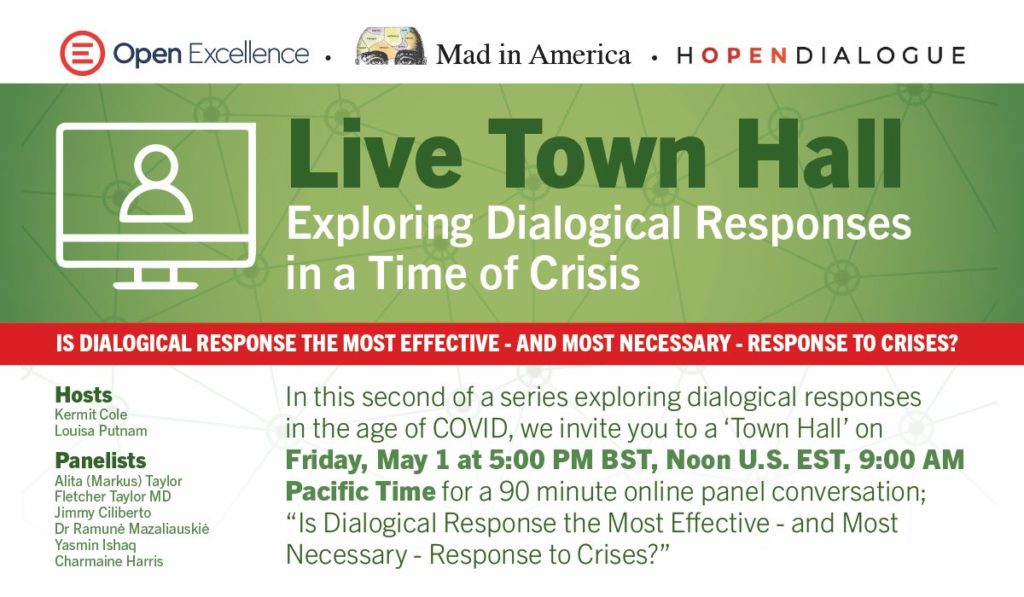
In the spirit of the quote above, Louisa Putnam and I put together the first “Dialogue in a Time of Crisis” town hall meeting in collaboration with Mad in America, HOPEnDialogue, and Open Excellence two weeks ago. We had heard many stories of friends and colleagues adapting their dialogical approaches during the COVID crisis, and we wanted to create a space to gather and learn as we all find a path forward. Over 360 people from 33 countries* joined the panel of Jaakko Seikkula, Rai Waddingham, Andrea Zwicknagl, Richard Armitage, and Iseult Twamley. Since then over 1000 people have watched or listened on YouTube.
Many of those responding spoke of being touched by the respectful atmosphere, with space and time allowed for thoughts to form, and new meaning to arise. This, to me, is the essence of the dialogic approach: finding our way forward in uncertain times by opening up, not ending, the dialogue. It seems paradoxical that when we are most afraid we would let go of the desire for a quick fix. But perhaps the fact that we are relational, social beings means that crisis brings out the need to look to the collective. The fact that so many people found their way to this forum and found comfort in it was, for Louisa and I and all that gathered to participate, very fulfilling. Equally fulfilling as the discussion and the reaction to it was the lively exchange in the chat section, as people from around the world signed on to say hello, meet, comment, and exchange contact info. Similarly, the Q&A was rich with experience and poignant in its immediacy.
I am trying to find the silver lining every day. I am grateful I have a job I can do from home that contributes to the public health efforts especially during this time that I will refer to here as the “situation”. I am also grateful that I have a home – a roof over my head and a place I can call my own! Hello-right?!? So many don’t have stable housing, employment , health care coverage (oh to be in the US now…) and access to food. And what’s up with the run in the stores on toilet paper (Elaine from Seinfeld – “can you spare a square?”- Uhhmm, No.)?!?. Perhaps the bidet really is a good idea!?

From 2012 to 2018, Parachute NYC offered a “soft landing” for people experiencing psychiatric crisis in New York City. Along with a respite center, Parachute mobile teams consisted of teams of health care professionals, including peer specialists, psychiatrists, social workers, and family therapists, who were each trained in the principles of Open Dialogue and Intentional Peer Support. Open Dialogue, developed in Western Lapland in Finland, espouses a practice of healing through polyphonic (many voices) dialogue within a non-hierarchical network, tolerating uncertainty, and treating every utterance as meaningful and rational. Intentional Peer Support, developed by and for peer specialists, embraces crisis as opportunity, mutual accountability within partnerships, and trauma-informed care. Parachute represented the first instance in which peer specialists were integrated into the Open Dialogue model.
Read MoreThe Hearing Voices movement began in Europe in the late 1980s when Marius Romme, a psychiatrist, realized that his training and therapeutic techniques were not helping one of his patients to manage the voices in her head. In listening to Patsy Hage, Romme began to wonder if maybe other voice-hearers might be in a better position to help her than he was. His hunch turned out to be correct, and the Hearing Voices Network (HVN) was co-founded by Romme and Hage in 1987.
The HVN is a peer-to-peer, nonclinical support group based on the radical idea that voice-hearing is not automatically a sign of pathology. Unlike traditional methods that encourage voice hearers not to engage with or listen to their voices, the HVN takes the opposite approach: voice-hearers are encouraged to explore and discover for themselves what their voices mean. The groups also provide social support and acceptance- something that is vitally important given the social distancing and isolation often reported by voice hearers. And the groups offer practical strategies for living with and managing voices.
Read MoreIn the United States, media representations of voice-hearers are rare and mostly negative. When our stories *are* shared, we are often portrayed as one-dimensional, irrational, violent or unable to contribute to our communities. Research indicates that one in ten people hear voices at some point in their adult lives, however; negative media representation leads many to stay silent about these experiences. We now know that that silence and isolation can make an experience of hearing voices more distressing and harder to navigate.
With the Hearing Voices approach, we create space for voice-hearers to share their experiences in all their individual complexity. We see over and over the healing value of articulating what our voices say, how long they have been in our lives, and what life events they might relate to. We have seen the importance of making room for trauma-informed and culturally-competent understandings of both why voices/visions occur and what healing practices are available.
Read More
Is diagnosing a person and labeling them as mentally ill truly helpful? Ironically, when I first entered therapy it was because I feared mental illness. I did my best going to therapy for over 16 years, but to no avail. I received not one diagnosis but four of them. I finally realized that the mental health system is designed primarily to diagnose and place labels on human beings. These diagnoses or labels not only deem people to be mentally ill or defective, they also often prevent people from reaching their true potential.
Read More